








Commercial Solar Pathway Lighting

Self-powered pathway, walkway and bike path lighting for councils, engineers, infrastructure owners and contractors. No trenching, cabling or power bills, with every system designed to the lighting category your site requires.

  • No Trenching, Cabling or Power Bills
  • Lighting Designed to AS/NZS 1158
  • Designed for Australian Winter Conditions
  • Site-Specific Solar and Battery Design
  • Engineered for Reliable All-Night Operation

Off-Grid Lighting for Paths, Walkways and Bike Tracks

Lighting shouldn’t stop where the grid does.

Green Frog Systems designs commercial solar pathway lights for councils, engineers, infrastructure owners and contractors who need paths, walkways and public spaces lit reliably, every night, without the cost and disruption of a grid connection. Every solar pathway light is self-powered, so there’s no trenching, no cabling and no power bills. Engineered in Australia since 2011, each system is designed to the lighting category the site requires under AS/NZS 1158.

Designed to AS/NZS 1158 for Pedestrian Areas

Pathway lighting in Australia is designed to AS/NZS 1158.3.1, which sets Category P lighting levels for pedestrian and cycle paths. Rather than guessing at brightness, every project gets a project-specific photometric design that matches the lighting layout to the category the site needs. We support each project from the first site assessment through to project planning.

Step 1

Site Assessment

We start with the path itself: its width, how it’s used, the lighting category it needs and the site’s location, shading and solar resource.

Step 2

Lighting Plan and Photometric Design

We develop the lighting plan and model the photometrics, so councils and engineers have compliant layouts and the documentation they need at every stage.

Step 3

Solar and Battery Sizing

Solar generation and battery storage are then sized for the site’s worst case winter conditions, so the lights keep running through short days and cloudy weeks.

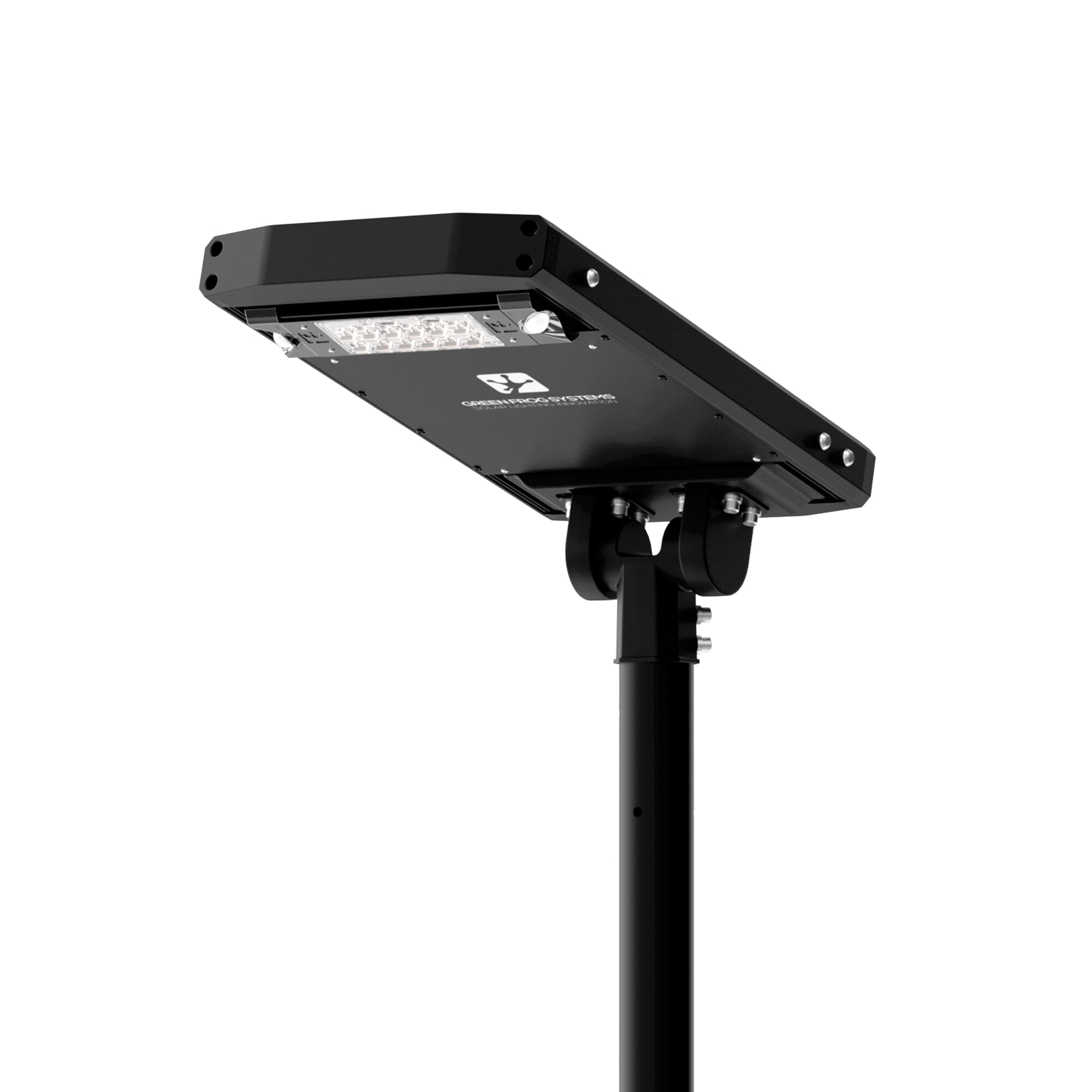
Pathway Lights and Solar Bollards

From solar bollard lights for edges and entrances to modular lights for larger paths. Compare where each fits best, or switch to key specs.

Solar bollard light

Explorer

  • Path edges
  • Entrances
  • Public spaces
  • Architectural settings

All-in-one solar light

Defender

  • Footpaths
  • Walking trails
  • Reserves
  • Car park walkways

Modular solar light

Aeromax

  • Shared paths
  • Bike tracks
  • Foreshores
  • Car park walkways

Dual panel modular light

Aeromax Dual

  • Wide shared paths
  • Active transport corridors
  • Larger pathways
  • Minor roads

Solar bollard light

Explorer

  • 360° or 180° illumination
  • Up to 638 lm, adjustable output
  • Microwave motion sensing
  • LiFePO4 battery, 2–9 nights autonomy
  • IP65, IK10
  • Flange base plate or in-ground mounting

All-in-one solar light

Defender

  • Up to 1,734 lm (10 W)
  • Twin PIR sensors
  • 32 Wp solar panel
  • LiFePO4 battery
  • IP66, IK08
  • 3000K, 4000K or 590nm turtle friendly

Modular solar light

Aeromax

  • 2,474–4,911 lm (16–35 W)
  • PIR boost, adjustable
  • 110 Wp solar panel
  • T3 optics (T2, T4, T5 options)
  • IP66, IK08
  • Modular, scalable design

Dual panel modular light

Aeromax Dual

  • 4,911–7,602 lm (35–60 W)
  • Dual panel design for larger paths
  • PIR boost, adjustable
  • T3 optics (T2, T4, T5 options)
  • Modular, scalable design

Looking for something else? Browse our full lighting products range.

Whole-of-Life Cost Compared with Grid Lighting

For paths without existing power, solar avoids the biggest costs of grid lighting. Here’s how the two compare.

Feature Solar pathway lighting Grid pathway lighting
No trenching ✓ ✕
No cabling to each light ✓ ✕
No grid connection needed ✓ ✕
No ongoing electricity bills ✓ ✕
Path stays open during installation ✓ ✕
Unaffected by grid outages ✓ ✕
Lighting designed to AS/NZS 1158 ✓ ✓
Lower upfront cost Site dependent Site dependent

The right choice depends on how far the path is from existing power, the lighting category and how the path is used. Where power already runs along a path, grid lighting can still make sense, and our team will tell you if that’s the case. Every complete lighting system is backed by a 5-year warranty.

Designed for the darkest weeks

Engineered for Winter, Shade and Worst-Case Sites

Our systems are typically designed for five or more nights of autonomy, with solar generation and battery storage sized to the site’s geographic location, lighting requirements and operating profile.

That’s the main difference between our commercial solar path lights and the garden-grade lights that make up most solar path lights in Australia. Garden lights are built around average sunshine. Green Frog solar lights are designed for the darkest weeks of the year, so paths stay lit through short winter days and cloudy weeks.

  • AS/NZS 1158.3.1
  • Photometric design
  • Worst case modelling
  • Motion sensing on every model
  • Designed and tested in Australia

Features by model

  • Motion sensing on every model: PIR on the Defender and Aeromax range, microwave on the Explorer. It can be switched off for constant all-night operation.
  • LiFePO4 batteries: on the Explorer and Defender, for long life and reliable performance.
  • Turtle friendly option: 590nm lighting on the Defender and Aeromax range, for coastal and foreshore sites.

Warranty

5-year complete system warranty.

Where Our Pathway Lighting Is Used

From suburban footpaths to coastal reserves, solar pathway lighting covers the routes where running power is costly, disruptive or impractical.

Defender 55 Solar Light Evanston Gardens SA

Pedestrian Paths & Walkways

Solar walkway lights for routes connecting neighbourhoods, parks and public facilities.

  • Footpaths
  • Shared paths
  • Neighbourhood links
  • Public facilities

Best fit Defender · Aeromax

Illuminating the Path to Safer Communities

Bike Tracks & Active Transport

Solar bike path lighting that supports night-time and early-morning use, with motion-activated or constant lighting.

  • Bike paths
  • Shared use paths
  • Commuter routes
  • Active transport corridors

Best fit Aeromax · Aeromax Dual

bike trail, pathway and minor road lighting

Walking Trails & Recreation

Improve access to community spaces while protecting natural surroundings. See our parks and public space lighting.

  • Walking trails
  • Reserves
  • Lake and river paths
  • Playgrounds

Best fit Defender · Explorer

jetty solar lighting

Foreshores & Coastal Paths

Light foreshore reserves and coastal routes where cabling is impractical, with turtle friendly 590nm options for sensitive sites.

  • Foreshore reserves
  • Coastal walks
  • Boardwalks
  • Jetty approaches

Best fit Defender · Aeromax

freeling carpark aeromax 3k 23

Car Park Walkways

Safe, well-lit routes between parking areas and entrances. See our car park lighting.

  • Car park paths
  • Entrances
  • Drop-off zones
  • Building approaches

Best fit Aeromax · Explorer

Solar powered street lighting - Wagga NSW

Minor Roads & Rural Paths

Light lesser-used or remote connections without mains-powered infrastructure.

  • Rural paths
  • Minor roads
  • Remote links
  • Township connections

Best fit Aeromax Dual

Pathway Lighting Projects

Green Frog solar pathway lighting is proven on real paths across Australia and overseas. At Lake Albert in Wagga Wagga, 104 solar pathway lights run over 5.5 km, in what has been described as Australia’s longest continuous solar pathway installation. Today, our Aeromax range carries that design forward. Read the Lake Albert case study.

Lakes Entrance Stage 2

Smart Solar Lighting | Stage 2 | Lakes Entrance, VIC

February 18, 2022

Pontesbury Cycle Path Lighting

Solar Cycle Path Lighting | Pontesbury | United Kingdom

January 25, 2022

City of Playford Solar Park Lighting Projects

Solar Park Lighting | City of Playford

September 9, 2021

Frequently Asked Questions

What lighting standard applies to council pathways in Australia?

AS/NZS 1158.3.1. It sets Category P lighting levels for pedestrian and cycle paths based on how the path is used. Green Frog designs the photometrics for each project to the category the site requires, so the lighting is compliant from day one.

How many lumens do solar pathway lights need?

It depends on the lighting category, not a single lumen figure. Under AS/NZS 1158.3.1, the right light level comes from a photometric design for the path, its width and how it’s used. For a general guide, see our article on how many lumens a solar light should be.

Do solar pathway lights work in winter?

Yes, when they’re designed for it. Our systems are typically designed for five or more nights of autonomy, with solar generation and battery storage sized to the site’s geographic location, lighting requirements and operating profile. That means designing for the darkest weeks of the year rather than average sunshine.

Can solar pathway lights run all night?

Yes. Every model has motion sensing, which boosts the light when someone approaches. Where a site needs constant lighting, motion sensing can be switched off so the light runs at a steady level all night, with the solar and battery sized to suit.

How long do commercial solar path lights last?

Green Frog backs every complete lighting system with a 5-year warranty. Commercial-grade components and site-specific engineering are what separate long-life public lighting from garden-grade path lights.

Are solar pathway lights worth it?

For paths without existing power, yes. Solar avoids trenching, cabling, a grid connection and ongoing electricity bills, and installation causes far less disruption to parks and paths already in use. Designed properly, it delivers compliant lighting without the infrastructure work.

Plan Your Next Pathway Lighting Project

Ask us about lighting specifications, layout design support, or available configurations for your site.

(08) 7200 3909
