

NOMAD 2

Portable Solar Power & Lighting Tower

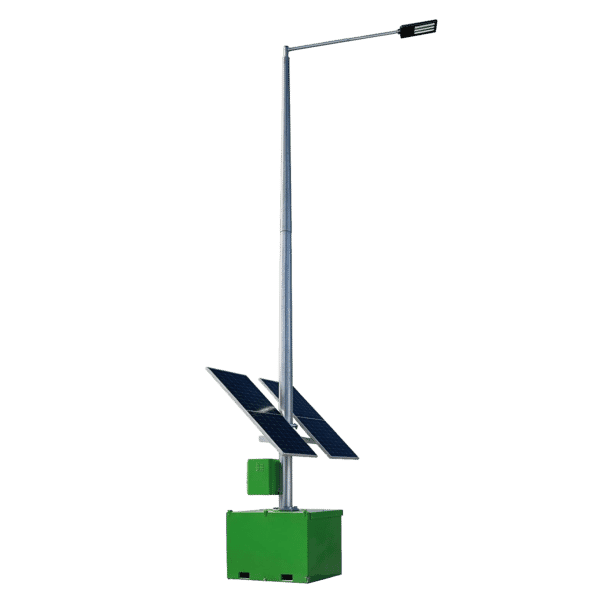
The Green Frog Systems NOMAD 2 portable solar power and lighting tower is a re-deployable solar power and lighting tower on an engineered sand-ballast base. A 1 kW independently rotating solar array, 10 kWh LiFePO4 battery and 6.0 m hand-winch telescopic mast provide lighting and off-grid power for remote sites. Two LED floodlights come standard, with a four-light option delivering up to 91,000 lm.

No crane, no concrete, no fuel.

data sheetDownload NOMAD 2 PDF

Description

NOMAD 2 — portable solar power & lighting tower

The Green Frog Systems NOMAD 2 portable solar power and lighting tower combines area lighting and off-grid power on an engineered sand-ballast base. Its 1 kW solar array rotates independently of the base, so a forklift can place the unit in any orientation and the array turns to face north.

Two 116 W LED floodlights provide 45,666 lm as standard, with a four-light option delivering up to 91,000 lm. Each floodlight aims and rotates independently. NOMAD 2 delivers general illumination to AS/NZS 1158.3.1:2020 Category P levels for mine sites, camps, laydown areas and work sites.

A 10 kWh LiFePO4 battery, with a 20 kWh option, is housed inside the vandal-resistant steel base. The same tower can support cameras, Wi-Fi, sensors and site equipment, with the lighting and power configuration specified for the deployment location.

The KX1000 smart controller runs the floodlights at full power and dims automatically at critical low battery. DC power and CAT5 data run internally on a retractable cable winder, with no exposed mast cabling. The 6.0 m hand-winch telescopic mast brings the lights to ground level for installation, aiming, cleaning and servicing.

Configure your NOMAD 2

Standard two-floodlight configuration

Two 116 W LED floodlights deliver 45,666 lm total, with fully independent aiming and rotation and 3000K CCT.

Optional four-floodlight configuration

Four 116 W LED floodlights deliver up to 91,000 lm for area lighting from a single tower. GFS can provide photometric simulations for your site layout, mounting height and aiming requirements.

LED outreach option

Single or dual outrigger arms, up to 3.0 m each side, carry high-output road-optic LED luminaires on the 6.0 m mast. This option provides directional road-style lighting for intersections and gates.

Lighting and off-grid power

Choose 10 kWh LiFePO4 storage as standard or the optional 20 kWh configuration. Constant, timed or adaptive power profiles are specified per site, with an optional Bluetooth interface for profiles, dimming and status. A second NOMAD 2 can be connected to double battery and solar capacity.

Rated for your wind region

Designed to AS/NZS 1170.2 — location dependent, meeting wind regions A–C on sand ballast and customisable to meet region D; engineered ballast schedule and certification documentation supplied per job site.

Fill the base with locally sourced sand or ore-based fill to the prescribed density and marked fill level per the engineered ballast schedule supplied with each unit. Concrete fill is an option for permanent installations and region D configurations. The mast retracts in minutes ahead of extreme weather.

Deploy and redeploy

  1. Fork the unit into position in any orientation.
  2. Fill the base to the marked level with the specified ballast, following the engineered ballast schedule.
  3. Rotate the array to face north and aim the floodlights at ground level.
  4. Hand-winch the mast to height.

When the project moves, empty the ballast, retract the mast and fork the unit onto the truck. NOMAD 2 ships upright with no disassembly, with up to 16 units per 40’HQ container.

Applications

  • Laydown yards and compounds
  • Mining camps and villages
  • Mine site road entries
  • Construction site entry points
  • Storage yards and security
  • Car parks and gatehouses
  • Events and festivals
  • Off-grid power
  • Emergency management and disaster response

Get a free site performance report

Every NOMAD 2 proposal includes a site performance report built from 20 years of NASA satellite solar data for your exact coordinates. The report covers month-by-month peak sun hours, the longest winter night, sustainable output and cloudy-weather reserve, verified against the worst month of the year.

If the selected configuration cannot hold full power through winter, the report identifies the adjustment required: the 20 kWh battery option, seasonal array tilt or KX1000 power scaling.

Autonomy and recharge times are engineered per site with worst-month solar verification, and will vary by location and season.

Contact us for pricing & specification

Send us your site and lighting or power requirements. We’ll verify the configuration against your wind region and worst-month solar data and put the performance in writing.
Call +61 8 7200 3909 or email sales@greenfrogsystems.com.au.

Key Features

1 kW rotating array. Two 500 W panels rotate independently of the base. Fork the unit into position in any orientation, then turn the array to face north. Site-specific panel plans are available.

Up to 91,000 lm. Two 116 W LED floodlights provide 45,666 lm as standard. The optional four-floodlight configuration delivers up to 91,000 lm, with independently adjustable aiming and rotation.

General illumination. NOMAD 2 delivers general illumination to AS/NZS 1158.3.1:2020 Category P levels for mine sites, camps, laydown areas and work sites. AS/NZS 1680.5 (outdoor workplace lighting) and AS/NZS 4282 (control of the obtrusive effects of outdoor lighting) form the supporting design basis.

Site-specific wind engineering. Designed to AS/NZS 1170.2 — location dependent, meeting wind regions A–C on sand ballast and customisable to meet region D; engineered ballast schedule and certification documentation supplied per job site.

Fully integrated cable management. DC power and CAT5 data run internally on a retractable cable winder built into the unit, protecting mast cabling from exposure and tampering.

Lighting and power storage. A 10 kWh LiFePO4 battery comes standard, with 20 kWh optional. Support lighting, cameras, Wi-Fi, sensors and other site equipment from the same tower.

KX1000 smart control. Full-power operation with automatic dimming at critical low battery. Constant, timed or adaptive profiles are specified per site, with an optional Bluetooth interface for profiles, dimming and status.

LED outreach option. Single or dual outrigger arms, up to 3.0 m each side, carry high-output road-optic LED luminaires on the 6.0 m mast for directional lighting at intersections and gates.

Vandal-resistant base. Batteries and controllers are housed inside the steel base, with optional anti-vandal bolts and supports.

Ground-level everything. The 6.0 m hand-winch telescopic mast brings the lights down for installation, aiming, cleaning and servicing with no work at heights and no EWP.

No crane, no concrete, no fuel. Place with a forklift, telehandler or loader with forks and fill with site-sourced ballast to the engineered schedule. Concrete fill is an option for permanent installations and region D configurations.

Expandable and multi-unit ready. Connect a second NOMAD 2 to double battery and solar capacity, or use spare base capacity for cameras, Wi-Fi and servers.

Emergency-ready. Ships upright in a 40’HQ container with no disassembly and supports long-term storage on trickle charge.

Nothing left behind. Empty the ballast and return it as clean fill. The hot-dip galvanised steel base can be redeployed or 100% recycled. Up to 16 units fit in a 40’HQ container.

Verified, not estimated. Every proposal includes a free site performance report using 20 years of NASA satellite solar data, checked against the exact site’s worst month.

Structural warranty. 10 years on the base and mast.

Technical

Model NOMAD 2
Product Type Portable solar power and lighting tower
Lighting Compliance
General Illumination Delivers general illumination to AS/NZS 1158.3.1:2020 Category P levels for mine sites, camps, laydown areas and work sites.
Supporting Design Basis AS/NZS 1680.5 (outdoor workplace lighting) and AS/NZS 4282 (control of the obtrusive effects of outdoor lighting)
Solar Specifications
Solar Array 1 kW total — 2 × 500 W panels
Array Mounting Independently rotatable — array turned to face north after placement
Panel Configuration Site-specific panel plans available
LED Floodlight Specifications
Standard Configuration 2 × 116 W LED floodlights
Standard Light Output 45,666 lm total
Optional Configuration 4 × 116 W LED floodlights
Optional Light Output Up to 91,000 lm total
CCT — Standard Floodlights 3000K
Aiming Fully independent floodlight aiming and rotation
LED Outreach Option
Outrigger Configuration Single or dual outrigger arms
Outreach Up to 3.0 m each side
Luminaires High-output road-optic LED luminaires
Mast Configuration 6.0 m mast only
Application Directional road-style lighting for intersections and gates
Battery & Storage
Battery Type LiFePO4
Standard Battery Capacity 10 kWh
Optional Battery Capacity 20 kWh
Battery Housing Inside the vandal-resistant steel base
Auxiliary Applications Cameras, Wi-Fi, sensors, servers and site equipment — configuration specified per site
Expansion A second NOMAD 2 can be connected to double battery and solar capacity
Control & Cable Management
Controller KX1000 smart controller — automatic dimming at critical low battery
Power Profiles Constant, timed or adaptive per site
Control Interface Optional Bluetooth — profiles, dimming and status
Cable Routing Fully internal DC power and CAT5 data on a retractable cable winder
Security Options Optional anti-vandal bolts and supports
Structure & Dimensions
Transport Envelope 1,150 × 1,523 mm — panels stowed
Base Height 600 mm — fork pockets
Transport Height 2,396 mm stowed — ships upright in 40’HQ, no disassembly
Deployed Mast Height 6.0 m
Deployed Width Less than 2.9 m
Mast Operation Hand-winch telescopic mast
Transport Weight Approximately 500 kg — battery dependent
Finish Hot-dip galvanised steel throughout
Ballast & Wind Engineering
Standard Fill Locally sourced sand or ore-based fill to the prescribed density and marked fill level, per the engineered ballast schedule supplied with each unit
Alternate Fill Concrete — permanent installations and region D configurations
Fill Method Top hatches; fill instruction sheet supplied per unit
Wind Engineering Designed to AS/NZS 1170.2 — location dependent, meeting wind regions A–C on sand ballast and customisable to meet region D; engineered ballast schedule and certification documentation supplied per job site.
Logistics & Operation
Handling Forklift, telehandler or loader with forks
Container Loading Up to 16 units per 40’HQ — upright, no disassembly
Storage Long-term storage on trickle charge
Redeployment Empty ballast, retract mast and fork out — ships complete to the next project on a local freight carrier
Servicing Ground-level installation, aiming, cleaning and servicing using the hand-winch telescopic mast
Operation Silent solar operation; no fuel or refuelling
Site Performance & Warranty
Site Performance Report Included with every proposal — 20 years of NASA satellite solar data for the exact site, verified against the worst month
Report Coverage Month-by-month peak sun hours, longest winter night, sustainable output and cloudy-weather reserve
Structural Warranty 10 years — base and mast

Autonomy and recharge times are engineered per site with worst-month solar verification, and will vary by location and season.