

NOMAD 4

Solar Street-Lighting Tower

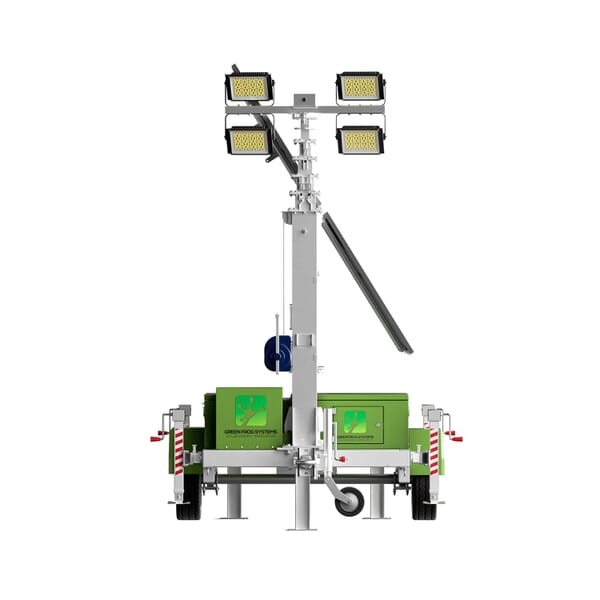
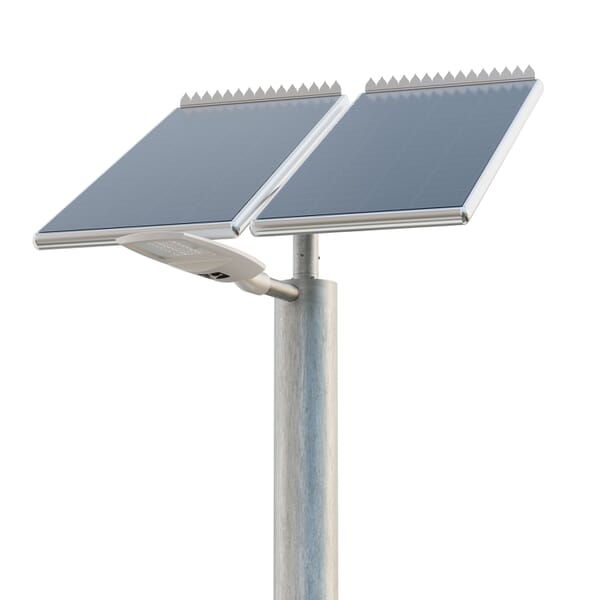
The Green Frog Systems NOMAD 4 solar street-lighting tower is a re-deployable solar street light for road construction, mining and civil infrastructure. Choose one or two high-output road-optic LED luminaires at an 11.5 m mounting height, supported by a 1 kW rotating solar array and 10 kWh LiFePO4 battery.

No concrete footings, no grid connection, no fuel. The base is placed by forklift; pole erection requires a crane or lifting device.

data sheetDownload NOMAD 4 Single LED PDF

data sheetDownload NOMAD 4 Twin LED PDF

Categories: , ,

Description

NOMAD 4 — solar street-lighting tower

The Green Frog Systems NOMAD 4 solar street-lighting tower provides re-deployable road lighting for road construction, mining and civil infrastructure. One or two high-output road-optic LED luminaires mount at 11.5 m, with drive power adjusted to suit the lighting design.

NOMAD 4 is designed to meet full AS/NZS 1158 road lighting — Category P and Category V, categories 1–5. Lighting designs and site-specific performance reports are provided with proposals.

A 1 kW solar array on a rotating T-piece mount charges a 10 kWh LiFePO4 battery. The KX1000 smart controller provides automatic power scaling, while satellite connectivity enables remote monitoring and control where mobile coverage is unavailable. An optional second 10 kWh battery supports cameras, sensors, telemetry and other site devices.

The base is forked into position and filled with locally sourced ballast to the engineered schedule. Erecting the pole requires a crane or lifting device at each installation. With no concrete footings or grid connection, the tower can move as traffic staging and project requirements change.

Single arm or twin

NOMAD 4-1000-A — single arm

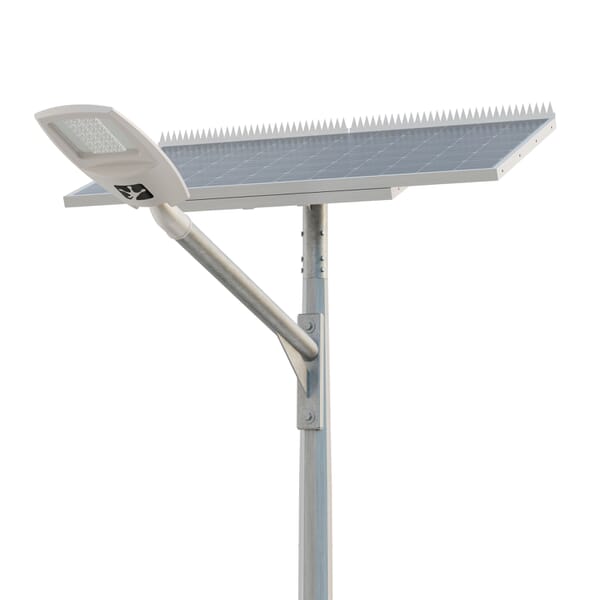
One 150 W high-output road-optic LED luminaire on a 4.0 m single arm, with an 11.5 m mounting height. Zero-sun reserve is engineered per site.

NOMAD 4-1000-B — dual arm

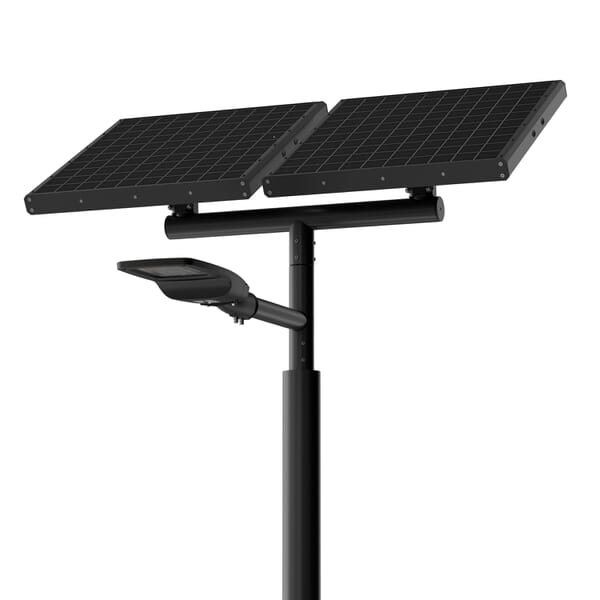
Two 150 W high-output road-optic LED luminaires, delivering 300 W total, on two 3.0 m arms with a 6.0 m tip-to-tip span. The mounting height is 11.5 m. Zero-sun reserve is engineered per site.

Both configurations offer road optics and 3000K or 4000K CCT, with drive power adjusted to suit the site lighting design.

Zero-sun reserve is engineered per site, and site-specific figures are provided with every proposal.

Moves with the project

NOMAD 4 suits staged road construction, detours, carriageway switches and haul-road intersections. On redeployment, empty the ballast and return it to site as clean fill, lower the pole with a crane or lifting device, and fork the base onto transport. Re-ballast and re-erect the tower at its next location to the site-specific engineered schedule.

Deployment

  1. Fork the base into position.
  2. Fill with locally sourced ballast to the prescribed density and marked fill level, following the engineered ballast schedule.
  3. Rotate the solar array to face north.
  4. Erect the pole to its 11.5 m mounting height with a crane or lifting device and aim the luminaires to the lighting design.

Applications

  • Road construction work zones and detours
  • Staged carriageway switches
  • Haul-road intersections
  • Mining camps and ROM areas
  • Ports and rail corridors
  • Utilities and civil infrastructure
  • Remote sites without mobile coverage

Specified for your site

Every NOMAD 4 proposal includes a site-specific performance report, checked against the worst month of solar data for the deployment location. GFS specifies the lighting category, wind region and solar performance for the project and provides the results in writing.

Solar performance figures are engineering estimates from long-term climatological averages and are not a guarantee of energy yield; a site-specific verified performance report is provided with every proposal.

Contact us for pricing & specification

Tell us your site location and lighting requirements. We’ll recommend the single- or dual-arm configuration and verify the lighting design, wind engineering and worst-month solar performance for your project.
Key Features

Road-lighting design. Designed to meet full AS/NZS 1158 road lighting — Category P and Category V, categories 1–5. High-output road-optic LED luminaires mount at 11.5 m, with drive power adjusted to the site lighting design.

Single- or dual-arm configuration. NOMAD 4-1000-A carries one 150 W luminaire on a 4.0 m arm. NOMAD 4-1000-B carries two 150 W luminaires, delivering 300 W total, on two 3.0 m arms, with a 6.0 m tip-to-tip span.

Moves with the project. Forklift pockets allow the base to be placed and relocated as traffic staging changes. Pole erection and lowering require a crane or lifting device.

No concrete footings. Fill the base with locally sourced sand, aggregate or ore-based fill to the engineered ballast schedule. On redeployment, ballast is returned to site as clean fill, leaving no footing to demolish.

1 kW rotating solar array. Two 500 W panels sit on a rotating T-piece mount so the array can be oriented after base placement.

10 kWh battery storage. A 10 kWh LiFePO4 battery comes standard. An optional second 10 kWh battery supports cameras, sensors, telemetry and other site devices.

KX1000 smart controller. Automatic power scaling helps protect the battery during extended overcast conditions.

Satellite connectivity. Remote monitoring and control without mobile coverage. View fleet status, battery state and lighting schedules from the office.

Site-specific power plan. Every proposal includes a performance report checked against the deployment site’s worst month of solar data.

No fuel or refuelling visits. Silent solar operation with no grid connection.

Engineered structure. Hot-dip galvanised steel, designed to AS/NZS 1170.2 with wind region and terrain category addressed in the engineered ballast schedule supplied per job site.

Structural warranty. 10 years, per GFS T&Cs.

Technical

Model NOMAD 4
Model Codes 4-1000-A — single arm / 4-1000-B — dual arm
Lighting Compliance
Road-Lighting Design Designed to meet full AS/NZS 1158 road lighting — Category P and Category V, categories 1–5.
Site Lighting Design Road-optic luminaires with drive power adjusted to suit the lighting design; lighting designs and site-specific performance reports provided with proposals
Solar Specifications
Solar Array 1,000 W total — 2 × 500 W panels
Array Mounting Rotating T-piece mount
Array Orientation Rotated to face north after base placement
Controller KX1000 smart controller — automatic power scaling
LED Specifications
Luminaire Type High-output road-optic LED luminaire
LED Quantity 4-1000-A: 1 luminaire / 4-1000-B: 2 luminaires
LED Power 4-1000-A: 150 W / 4-1000-B: 2 × 150 W, 300 W total
Drive Power Adjustable to suit the site lighting design
Optics Road optics
CCT 3000K / 4000K
Battery & Storage
Battery Type LiFePO4
Standard Battery Capacity 1 × 10 kWh
Optional Battery Capacity 2 × 10 kWh
Auxiliary Power Optional second 10 kWh battery for cameras, sensors, telemetry and other site devices
Structure & Dimensions
Luminaire Mounting Height 11.5 m
Overall Height 11,630 mm to mast tip, excluding luminaire
Single-Arm Outreach 4-1000-A: 4.0 m
Dual-Arm Outreach 4-1000-B: 2 × 3.0 m arms, 6.0 m tip-to-tip
Upper Mast 7,000 mm
T-Piece 1,619 mm
Base Dimensions 1,500 × 1,500 × 1,106 mm — forklift pockets
Empty Base Weight 548 kg — ballasted on site to the engineered schedule
Finish Hot-dip galvanised steel throughout
Ballast & Wind Engineering
Standard Fill Locally sourced sand, aggregate or ore-based fill to the prescribed density and marked fill level, per the engineered ballast schedule supplied with each unit
Fill Method Top-fill to marked level on site
Wind Engineering Designed to AS/NZS 1170.2 — wind region and terrain category per the engineered ballast schedule supplied per job site
Deployment & Operation
Base Placement Forklift placement
Pole Erection Crane or lifting device required at each installation
Deployment Sequence Fork base into position, fill ballast, rotate array, then erect pole with a crane or lifting device and aim luminaires to the lighting design
Redeployment Empty ballast, lower pole with a crane or lifting device, and fork base out; re-ballast and re-erect at the next location
Footings & Power Supply No concrete footings or grid connection
Operation Silent solar operation; no fuel or refuelling
Connectivity Satellite remote monitoring and control — no mobile coverage required
Remote Functions Fleet status, battery state and lighting schedules
Solar Reserve
4-1000-A Zero-Sun Reserve Engineered per site
4-1000-B Zero-Sun Reserve Engineered per site
Reference Conditions Engineered per site; site-specific figures supplied with every proposal
Site Performance Verification Worst-month solar assessment for the deployment location, with a site-specific performance report supplied with every proposal
Warranty
Structural Warranty 10 years, per GFS T&Cs

Solar performance figures are engineering estimates from long-term climatological averages and are not a guarantee of energy yield; a site-specific verified performance report is provided with every proposal.

FAQ

Which NOMAD do I need?

Pick by the job. NOMAD 1 is general lighting for paths, camps and site access. NOMAD 2 is large-area lighting for laydowns, car parks, storage yards, security and disaster response. NOMAD 4 is temporary road lighting for roadworks and dangerous intersections. Not sure? Send us your site and we’ll recommend one, with a free site performance report.

Is the NOMAD 4 compliant for road lighting?

NOMAD 4 is designed to meet full AS/NZS 1158 road lighting — Category P and Category V, categories 1–5. Its high-output road-optic LED luminaires mount at 11.5 m, with drive power adjusted to suit the lighting design for your site. Lighting designs and site-specific performance reports are provided with proposals.

What is the difference between the single- and dual-arm models?

NOMAD 4-1000-A has one 150 W luminaire on a 4.0 m single arm. NOMAD 4-1000-B has two 150 W luminaires, delivering 300 W total, on two 3.0 m arms with a 6.0 m tip-to-tip span. Both configurations have an 11.5 m luminaire mounting height.

How long does the NOMAD 4 run without sun?

Zero-sun reserve is engineered per site for both NOMAD 4-1000-A and NOMAD 4-1000-B. Your site’s figures are assessed against 20 years of NASA solar data and supplied in writing. Solar performance figures are engineering estimates from long-term climatological averages and are not a guarantee of energy yield; a site-specific verified performance report is provided with every proposal.

Does the NOMAD 4 need a crane?

The base is placed by forklift, but erecting the pole to its 11.5 m mounting height requires a crane or lifting device at each installation.

How do you move a NOMAD 4 between work zones?

Empty the ballast and return it to site as clean fill, lower the pole with a crane or lifting device, and fork the base out. The tower is re-ballasted and re-erected at the next location to the site-specific engineered schedule, with no concrete footing to demolish.

Can I monitor a fleet of NOMAD 4 towers remotely?

Yes. Satellite connectivity provides remote monitoring and control without mobile coverage. View fleet status, battery state and lighting schedules from the office.

Can the NOMAD 4 power other site equipment?

An optional second 10 kWh battery supports cameras, sensors, telemetry and other site devices from the same tower. GFS specifies the configuration for the site’s requirements.

How do I buy a NOMAD 4?

Contact Green Frog Systems for pricing and specification — Every NOMAD 4 is specified to its site: lighting category, wind region and worst-month solar performance, in writing.