


Site lighting that moves with the job.
NOMAD turns site lighting into a reusable asset — simple to deploy, easy to service and ready for the next project. No permanent foundations. No weekly diesel refuelling. Nothing left behind.
Designed & Engineered in South Australia
Wind Engineering to AS/NZS 1170.2
Lighting to AS/NZS 1158
10-Year Structural Warranty
15 Years Supplying Certified Solar Lighting





NOMAD turns site lighting into a reusable asset — simple to deploy, easy to service and ready for the next project. No permanent foundations. No weekly diesel refuelling. Nothing left behind.
Replace diesel towers, trailers and fixed poles with lighting that runs itself and moves with the job.
Diesel towers need refuelling, servicing and someone to look after them, and they run loud all night. NOMAD runs on sunlight alone, with no fuel, emissions or noise. On NOMAD 2 and 4, the smart controller stretches power through overcast spells so the lights stay on until sunrise.

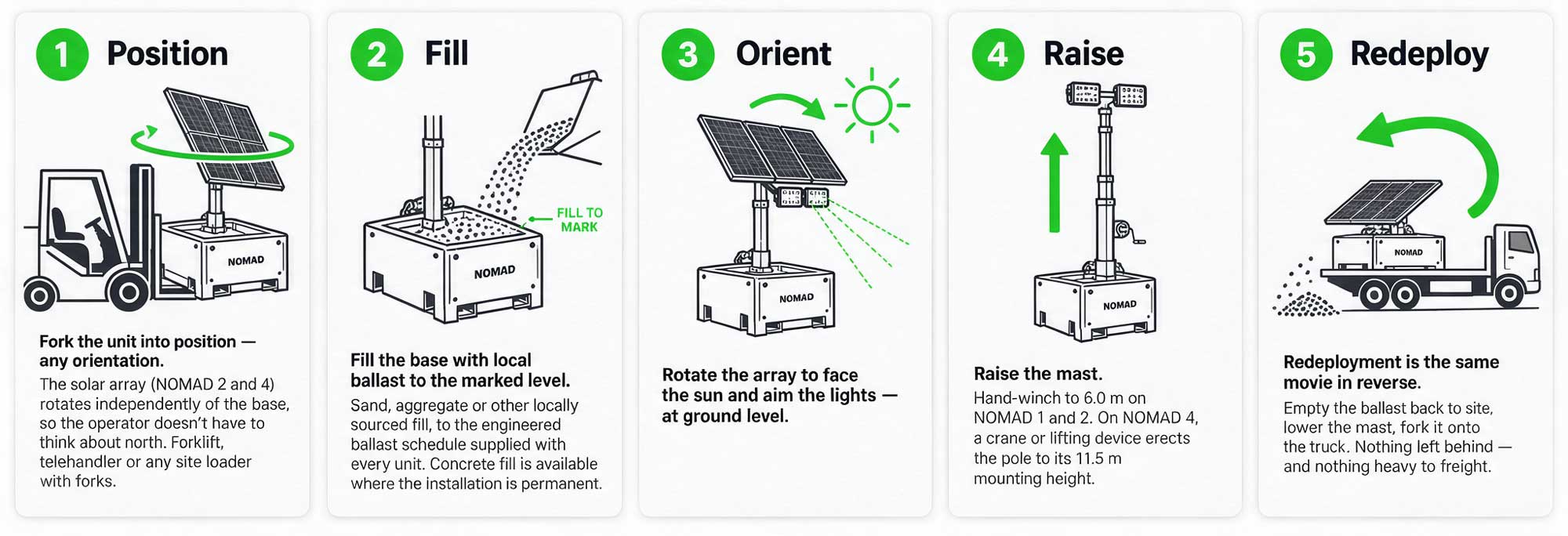
Fill the base with local ballast like sand or aggregate. There’s no digging or concrete, and nothing to reinstate when you leave. A forklift or telehandler places NOMAD 1 and 2. NOMAD 4’s base goes in the same way, and its 11.5 m pole needs a crane once, at installation.

Every NOMAD is wind-rated to AS/NZS 1170.2 for your location (regions A–C, with region D on request). Each unit comes with an engineered ballast schedule and site certification. Lighting is designed to AS/NZS 1158, from pathways and car parks up to full road lighting on NOMAD 4.

On NOMAD 1 and 2, a hand winch lowers the light head to the ground for aiming, cleaning and servicing. You won’t need an elevated work platform or a working-at-heights permit.

Fixed poles stay in the ground, and hired diesel towers never stop costing. Empty the ballast and NOMAD moves to the next site on standard freight, with up to 18 NOMAD 1s or 16 NOMAD 2s per 40′ container. Between jobs, keep it on trickle charge.

Three towers on one re-deployable platform. Compare where each fits best, or switch to key specs.
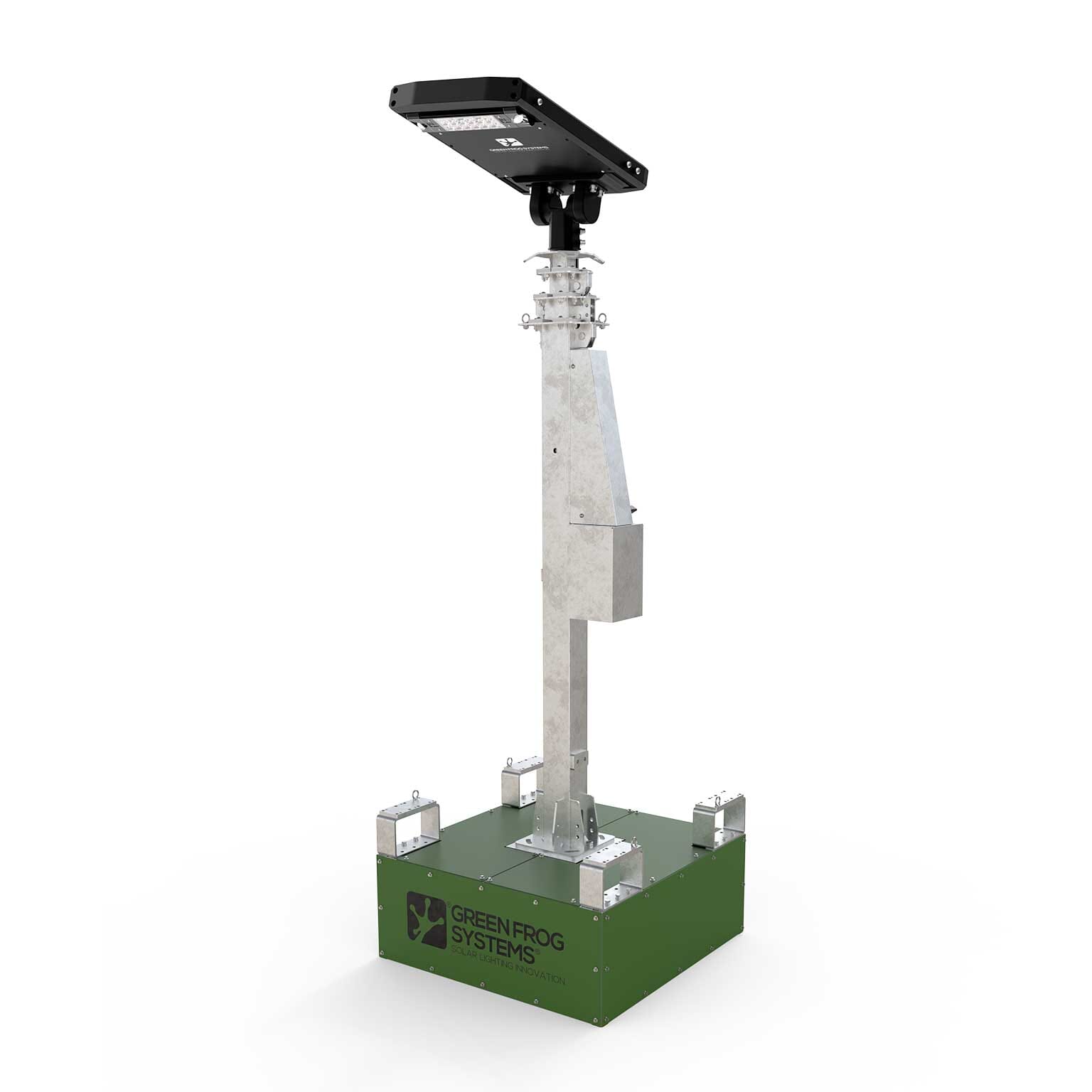
Portable solar lighting tower
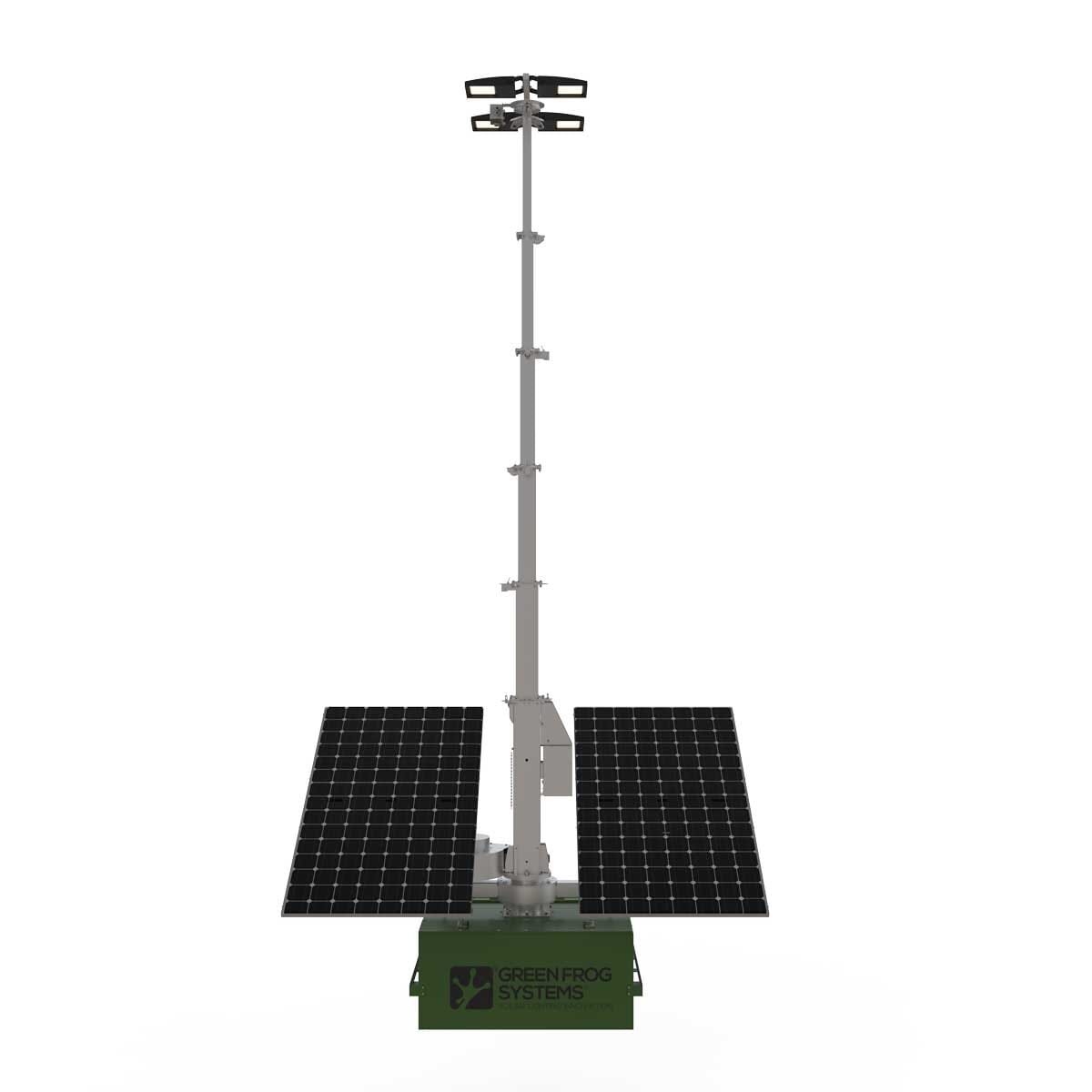
Most versatile
Portable solar power & lighting tower
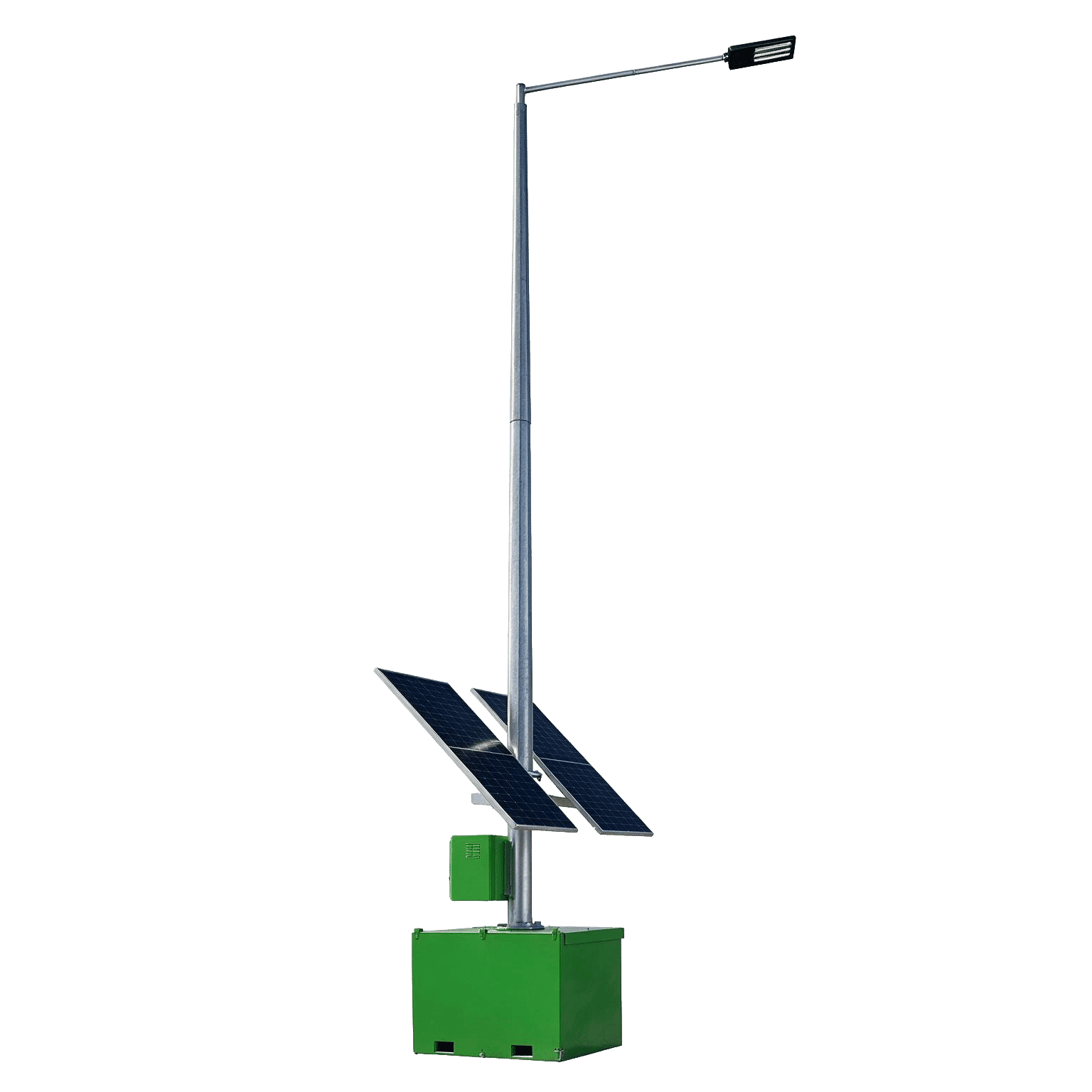
Solar street-lighting tower
Portable solar lighting tower
Most versatile
Portable solar power & lighting tower
Solar street-lighting tower
Ballasted weight depends on the engineered ballast schedule. Lighting category is subject to project-specific lighting design. Autonomy varies with location, season, lighting configuration and operating profile.
Site performance report
Solar lighting fails when it’s sized for the brochure, not the site. Every NOMAD 2 and NOMAD 4 proposal comes with a performance report built from 20 years of NASA satellite solar data for your exact coordinates.
It shows peak sun hours month by month, the longest winter night, cloudy-weather reserve and what the tower delivers in the worst month of the year. If a configuration can’t hold full power through winter, we tell you before you buy and show you the fix: a bigger battery, seasonal tilt or smart power scaling.
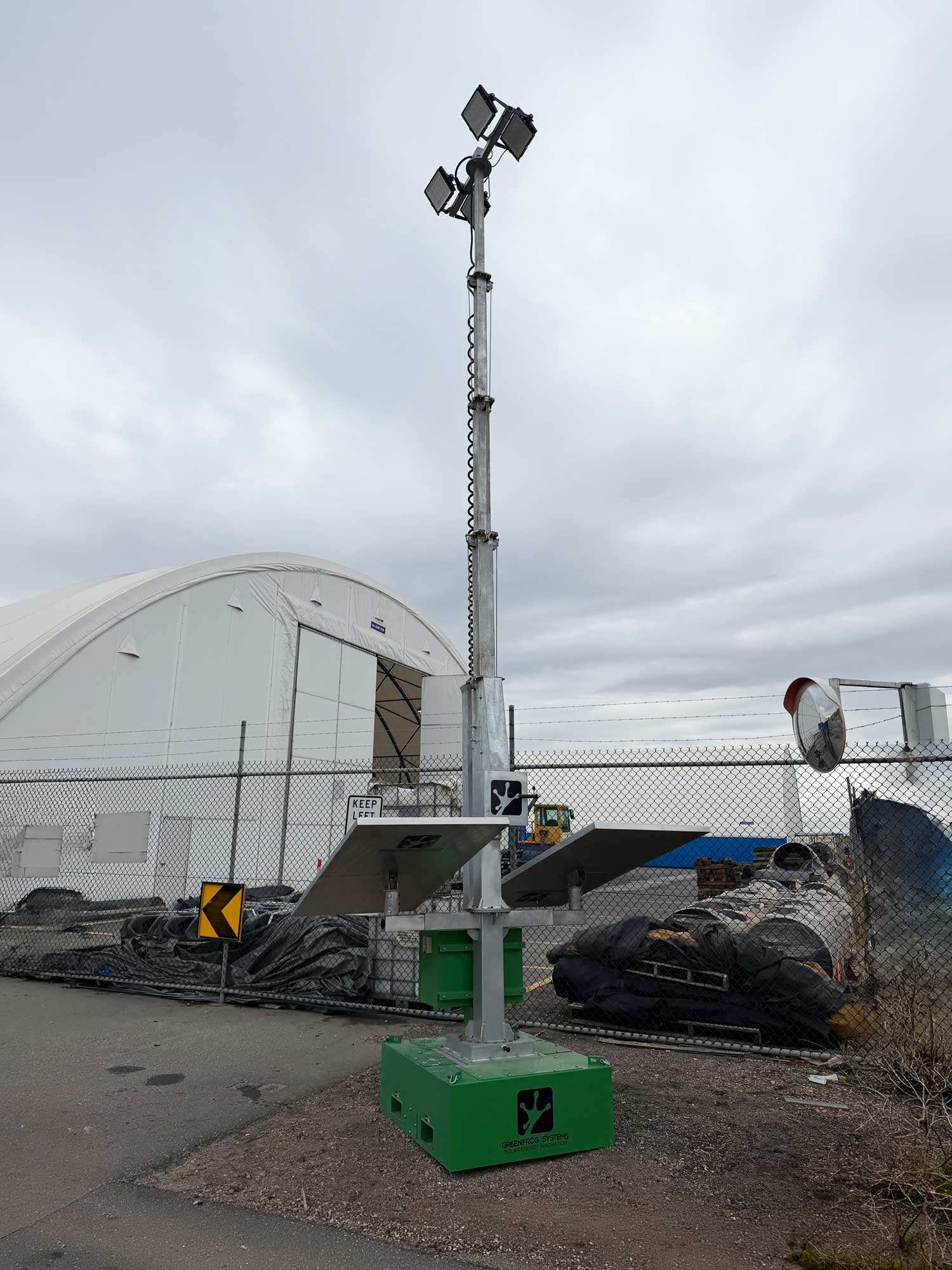
From haul roads to boat ramps, NOMAD covers the jobs where there’s no grid, no fuel run and no time for civil works.

Temporary solar lighting for roadworks, traffic management and staged construction projects, with relocatable systems that adapt as works progress.
Best fit NOMAD 4 · NOMAD 2

Off-grid lighting for mine access roads, operational areas and remote worksites, without the need for diesel generators or grid connections.
Best fit NOMAD 2 · NOMAD 4

Independent solar lighting and power for site entrances, security systems and storage yards where permanent electrical infrastructure is unavailable.
Best fit NOMAD 2

Relocatable solar lighting and power for major infrastructure projects, temporary works and locations where conventional electrical supply is impractical.
Best fit NOMAD 4

Flexible solar lighting for public spaces, car parks and community facilities, supporting seasonal activities and changing operational requirements.
Best fit NOMAD 1

Portable solar lighting and power for outdoor events, temporary venues and public gatherings, without generators or temporary electrical connections.
Best fit NOMAD 2

Rapidly deployable solar lighting and power for emergency operations, temporary facilities and remote locations with limited electrical infrastructure.
Best fit NOMAD 1 · NOMAD 2

Reusable solar lighting assets designed for repeated deployment, reducing fuel requirements, servicing demands and ongoing operating costs.
Best fit All NOMAD models
NOMAD is a family of re-deployable solar lighting and power towers made by Green Frog Systems in Australia. Each tower sits on an engineered steel base that is forklifted into position and ballasted on site with locally sourced fill — no concrete footings, no fuel and no grid connection. The range covers a 6.0 m general-illumination tower (NOMAD 1), a 6.0 m power and floodlighting tower with a 1 kW rotating solar array (NOMAD 2), and an 11.5 m solar street-lighting tower (NOMAD 4).
A NOMAD has no engine: no fuel deliveries, no oil or filter servicing, no exhaust emissions and no noise. Energy comes from a solar array charging a LiFePO4 battery, and the KX1000 controller automatically scales output in extended overcast so the light is still on at sunrise. Operating cost is effectively zero.
Yes. NOMAD 1 and NOMAD 2 are designed to meet AS/NZS 1158.3.1:2020 Category P general illumination — the Australian Standard for pedestrian area lighting, specified for pathways, car parks, mining camps and villages, and site access roads. NOMAD 4 is designed to meet AS/NZS 1158 Category V road lighting, categories V1–V5. Structures are designed to AS/NZS 1170.2 with published ballast schedules.
Because an unrated tower that topples in high wind damages equipment, injures people and creates liability. Every NOMAD is engineered to AS/NZS 1170.2 for its location — sand-ballast configurations meet wind regions A–C, and units can be customised to meet region D — with certification documentation per job site. The retractable masts (NOMAD 1 and 2) can be lowered in minutes ahead of extreme weather.
Each NOMAD ships with an engineered ballast schedule: fill the base with locally sourced sand or ore-based fill to the prescribed density and the marked fill level, and the tower meets its AS/NZS 1170.2 rating for your wind region — no concrete footings, no engineering surprises. On redeployment the fill is emptied and returned to site, and the same schedule applies at the next location.
NOMAD 1 and NOMAD 2 need no crane at any point — they are placed by forklift, telehandler or any loader with forks, ballasted with local fill, and hand-winched to height. NOMAD 4’s base is forked into place the same way, but erecting its 11.5 m pole requires a crane or lifting device at installation.
It depends on the model, configuration and site. The NOMAD 1 DEFENDER 70 head uses power scaling and multiple program modes to deliver 3–5 nights of autonomy; the DEFENDER 55 head runs 4–8+ nights. NOMAD 4 carries a 10 kWh battery giving a zero-sun reserve of around 4.4 nights (single-luminaire) or 3.0 nights (twin) on the longest winter night at a representative SE Queensland site. Every NOMAD 2 and NOMAD 4 deployment is verified against 20 years of NASA solar data for the exact site, worst month first.
Contact Green Frog Systems for pricing and specification. Every NOMAD is specified to its site — lighting category, wind region and solar performance — so tell us the location and the job, and we’ll configure the right tower and put its performance in writing. Call +61 8 7200 3909 or email sales@greenfrogsystems.com.au.
Yes — NOMAD 1 and NOMAD 2 are designed for rapid deployment straight from a 40’HQ container and for long-term storage on trickle chargers, so a stored fleet is ready to light a site within hours of an emergency, with no fuel supply chain.
Ten years structural on the base and mast, per Green Frog Systems’ terms; light heads and batteries carry their own warranties. Green Frog Systems has supplied certified solar lighting for 15 years.
Tell us about your site and our team will be in touch.

© 2026 Green Frog Systems. | Privacy Policy | Terms & Conditions
 (08) 7200 3909