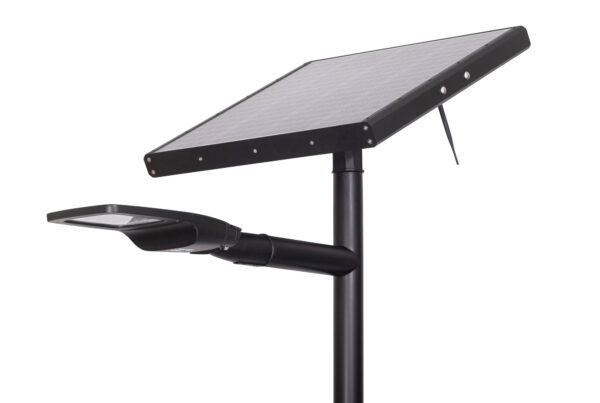



The solar street light systems has the advantages of stability, long service life, simple installation, safety, great performance and energy conservation. This type of light can be widely installed on urban roads, housing districts, factories, tourist attractions and parking lots. Solar street lights are independent of the power grid, reducing operating costs. This means that these are wireless lights and they are not connected to your electricity provider.
The lights depend on the solar energy emitted by the sun, storing as much as possible throughout the day. solar street lights require less maintenance than conventional street lights. These are less likely to overheat. As solar cables have no external cables, the risk of accidents is minimized.
What are the advantages of solar street lights?
Solar street lights are environmentally friendly because their solar panels rely solely on the sun, thus eliminating their contribution to carbon footprints compared to traditional lights. Some parts of solar street lighting systems can be easily transported to remote areas, making these solutions more efficient and practical for lighting problems. Solar street lights are pollution free and are inline with the current environmental protection concept.

Do solar street lights help you save money in the long run?
We believe that the solar street light will be widely applied and will become the ideal lighting system both in big cities and countries in the future. Because it is more energy efficient compared to traditional lights. By using the sun as power source this lighting structure can drastically reduce maintenance cost, replacement cost, operation cost and energy consumption. Even though the risk of solar related theft is higher than with traditional street lighting because solar-powered street lights are not wired. In addition, its higher cost also contributed to the risk.
Are solar street lights easier to install?


Solar panels converts solar energy from the sun into electrical energy using photovoltaic cells. A solar panel converts sunlight into electricity by converting light into an electric current to charge the rechargeable batteries. It works by absorbing photons from the sun and turning them into electrons.There is relatively little wire needed to connect the solar panels to the light fixture, and no external wires are necessary outside or near the base of the pole, so there are no safety issues.
Do solar street lights have lower labor and maintenance cost?
A solar lamp works automatically, requires no manual intervention, charges during the day and turns on at night. As it is a self-powered unit, this light does not depend on the mains to power it. In conclusion, solar street light can save installation fee, project cost and electricity bills. Although it has some disadvantages, the advantages of the solar street light are more than the traditional street light.
On the other hand, if there are advantages, solar street lights also have a number of disadvantages. It is also worth informing you of these few advantages just so that you can compare them with conventional lighting systems. In the end, you just have to decide whether the advantages outweigh the disadvantages or not. solar lights have many advantages; one of them is that it is a self-sustaining unit.
What are the disadvantages of solar street lights?

Despite the fact that cables are unlikely to be stolen, the luminaire and panel, which have a higher monetary value, are easy to steal. In general, solar powered lights require less maintenance than regular street lights. Solar street lights have fewer moving parts and minimal wiring. Since they are not connected to a power grid, there are no connection problems that need to be solved.
Do solar lights overheat?

Also, overheating is not a concern with solar street lights. As it is green today, some lighting projects attract the attention of local media and can increase your public presence, all because you place a sunlight in your parking lot. Modern lithium batteries used in solar street lights have a long service life compared to batteries used in previous years. Performance will be affected by continuous fog and rain weather, and the luminance or brightness of the light will not meet the global standard.
Do solar street lights require a higher initial investment?

However, there are also some restrictive factors in the application and promotion of solar street light. Here is an unbiased look at the pros and cons of solar energy and what it means in terms of green, both for the wallet and for the environment. According to a survey, the overall investment of installing a solar LED street light is three times the installation cost of a traditional street light of comparable efficiency. Solar energy, like any other energy source, has some advantages and disadvantages in its application, and understanding both sides is essential.
Are solar street lights the better choice?
As a light source one of the biggest disadvantages of solar lights is that due to extreme weather conditions, sometimes solar lights don’t provide optimal backup. Because of this, sustainable solar street lights are generally considered a practical lighting option. The most common advantages and disadvantages of a solar street lighting system have been presented here and it is obvious that the general advantages outweigh the disadvantages. Typically, commercial electric lighting projects are time-consuming and complicated as they involve cable foundation work, excavation, cable laying, threading cables into pipes and ditch dumps.
Impressed by modern sustainable and convenient street lighting solutions, corporations and governments are interested in installing solar street lights at intersections and other pedestrian places.