



If you’re lighting a footpath, local street, car park or town square in Australia or New Zealand, the lighting has to meet AS/NZS 1158.3.1. This is the standard for Category P lighting: spaces used mostly by people on foot or on bikes, where the main job of the lighting is helping people move safely and feel secure. Main traffic routes fall under Category V and are covered by a different part of the standard.
The standard does two things. First, it sorts every space into a lighting subcategory such as PR3, PP2 or PC1. Second, it sets the minimum amount of light each subcategory must get, and how evenly it must be spread.
This guide is for council staff, developers, builders and civil contractors who need to understand a lighting spec without being lighting designers. It explains what the codes mean, how a space gets its category, and what the terms in a lighting report actually measure. It’s a plain English introduction, not a substitute for the standard or a lighting design.
Step 1: Work out what type of space it is
Every Category P space belongs to one of five groups. The second letter of the code tells you which one.
| Code | Type of space | Typical examples |
|---|---|---|
| PR | Local road reserves | Residential streets, cul de sacs, local streets in commercial and industrial estates |
| PP | Pathways | Footpaths, shared paths, cycle paths, park paths, laneways and walkways |
| PA | Public activity areas | Town and suburban centres, outdoor malls, town squares, civic precincts |
| PE | Connecting elements | Subways, stairs, ramps and footbridges that link other spaces |
| PC | Outdoor car parks | Parking bays, aisles and car park roads, plus accessible bays (PCD) and pedestrian crossings (PCX) |
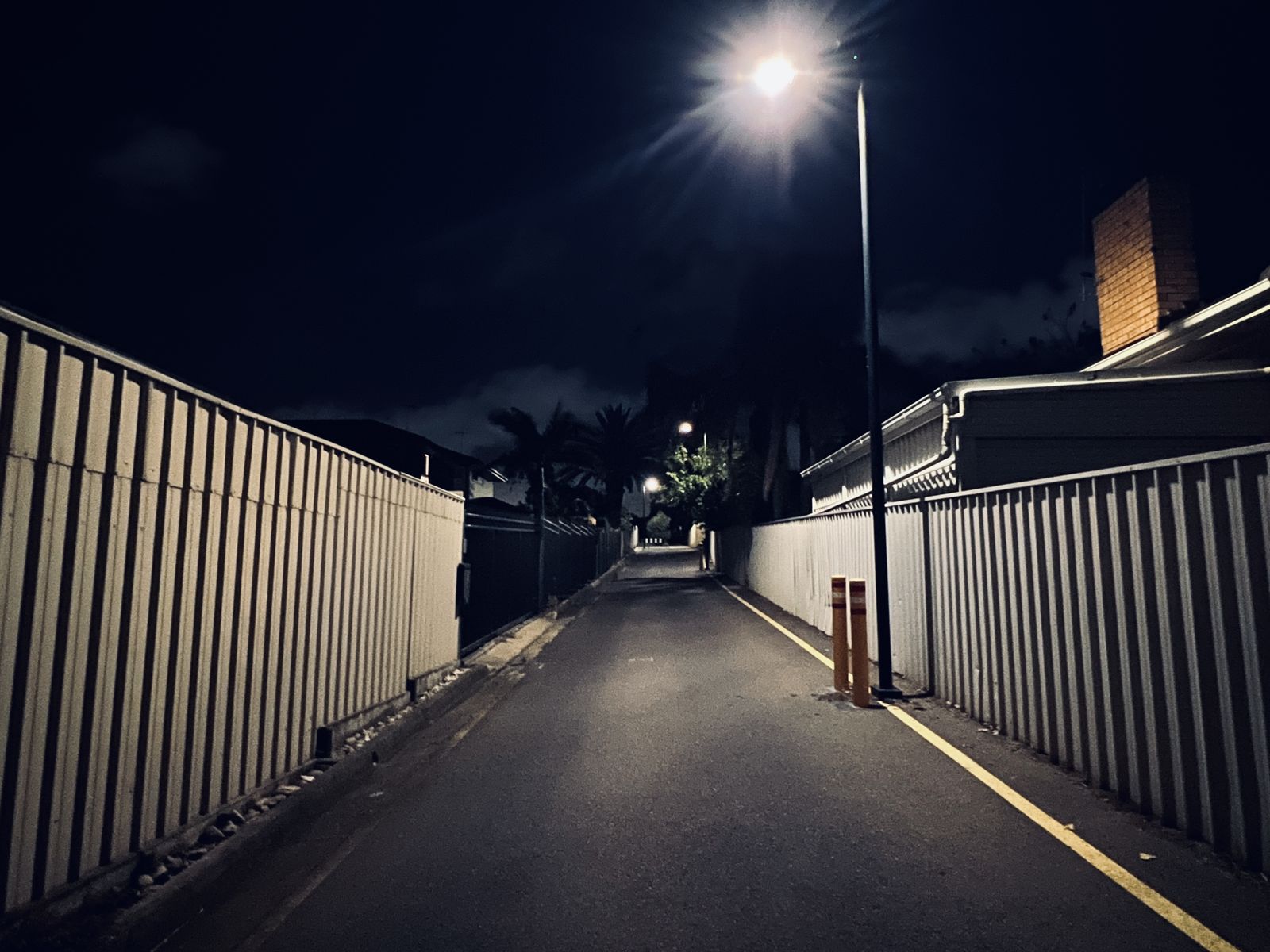
One project often contains several groups. A new subdivision, for example, might need PR lighting on the streets, PP lighting on the shared path through the reserve and PC lighting in the community centre car park.
Step 2: Choose the level within the group
Inside each group the number sets how much light is needed: 1 is the brightest, and the light needed drops as the number rises. The level is chosen by asking three questions about the space.
- How busy is it at night? This means pedestrian and cyclist activity after dark, not daytime traffic.
- How much fear of crime is there? This is about how safe people feel, not only reported crime. Lighting helps people see who is around them.
- Does the area need to look and feel inviting? Places where amenity matters, like a main street or civic square, get more light so they feel welcoming at night.
The answers are rated high, medium or low and matched to a subcategory. The local council or road authority often sets the subcategory for its own streets and paths, so check with them first.
The gap between the top and bottom of the scale is large. The quietest local streets need well under 1 lux on average, while busy town centres need more than 20 lux, and enclosed spaces like subways need more again. That’s why getting the subcategory right matters: it sets the size, number and cost of the lights.
Lighting terms explained
Lighting specs and design reports use a handful of terms over and over. Here’s what each one means.
| Term | Symbol | What it means in practice |
|---|---|---|
| Lux | lx | The amount of light landing on a surface. For a feel of scale, a full moon gives well under 1 lux, and a typical lounge room is around 100 lux. |
| Average horizontal illuminance | Ēh | The average light on the ground across the whole area. It’s the headline figure for how well lit a space is. |
| Point horizontal illuminance | Eph | The light at the darkest single spot on the ground. It stops designers hitting the average with a few bright patches and leaving dark holes in between. |
| Uniformity | UE2 | How evenly the light is spread, comparing the brightest spots with the average. A lower number means more even light. Even light matters because your eyes can’t adjust quickly between bright and dark patches. |
| Point vertical illuminance | Epv | Light falling on a vertical surface at about face height. It’s what lets you recognise a person coming towards you, which is why it applies to paths, public spaces and car parks. |
| Maintained values | The figures in the standard are the minimum the lighting must still deliver as it ages and gets dirty, not just on day one. See maintenance factor. |
Put simply, a compliant design has to get enough light on the ground overall, with no spot too dark, no patch too bright and, where required, enough light on people’s faces. For more terms, see our solar lighting glossary.
Common projects and their likely category
These are typical starting points, not rulings. The final subcategory depends on the site and the local authority’s policy.
| Project | Likely subcategory | Why |
|---|---|---|
| Quiet residential cul de sac | PR5 or PR6 | Low night activity, low fear of crime, little need for amenity |
| Residential street near shops or a school | PR3 or PR4 | More people walking at night and some amenity need |
| Shared path through a suburban park | PP3 or PP4 | Moderate night use; higher if the path feels isolated |
| Busy shared path linking a train station | PP1 or PP2 | High night use and a stronger need for people to feel safe |
| Main street or town square | PA1 or PA2 | Busy, high amenity, people gathering at night |
| Pedestrian underpass | PE1 | Enclosed spaces always need high light levels |
| Council or community centre car park | PC2 or PC3 | Depends on night use and security concerns |
| Shopping centre or transport hub car park | PC1 | Busy after dark with a higher security need |
A council is building a 600 m shared path through a park, linking a housing estate to a local shopping centre. Here’s how the subcategory would typically be worked out.
- Type of space. It’s a path used by people walking and cycling, so it’s in the PP group.
- Night activity. People use it after dark to get to and from the shops and the bus stop, but it’s not a main commuter route. That’s medium.
- Fear of crime. Parts of the path run behind back fences, out of view of houses and the road. Residents have raised concerns, so fear of crime is medium.
- Result. Medium activity and medium fear of crime point to PP3. If the council’s lighting policy already lists this path, that setting applies instead.

From there, the lighting designer models the path and chooses pole spacing, mounting height and fittings until the design meets every PP3 figure: the average, the darkest point, the evenness and the light at face height. For solar lighting, the panel and battery are then sized so it keeps meeting PP3 through winter.
Glare and light spill limits
Getting enough light on the ground is only half of compliance. The standard also limits how much light a fitting can throw where it isn’t wanted, which keeps it comfortable for people nearby and protects the night sky. There are three checks.
- Glare (DGI). This limits how dazzling a light looks to someone walking towards it. The allowed value is a little higher for fittings mounted at 6 m or more, because they sit further from your line of sight.
- Upward waste light (UWLR). This is the share of a fitting’s light that goes up into the sky instead of down onto the ground. It’s checked with the fitting tilted the way it will actually be installed. See upward light ratio.
- Light near the horizontal. This caps how bright a fitting can be when seen from the side, at angles close to horizontal, where light is most likely to cause glare or shine into nearby homes.
In practice, these limits mean choosing well shielded fittings with optics that aim light where it’s needed. A fitting with a flat glass face mounted level usually sends almost no light upwards.

What this means for solar lighting
Solar lighting can meet AS/NZS 1158.3.1, but the design has to hold up every night of the year, not just in summer. The standard doesn’t relax its light levels because a light runs off the sun, so a solar system needs to be sized for the hardest conditions.
- Light levels all night. If a project needs PP3, the lighting must deliver PP3 for the hours it’s required to run. Dimming during quiet hours is only acceptable where the design and the asset owner allow for it.
- Winter and cloudy weather. The panel and battery have to be sized for the shortest days and runs of cloudy weather at that site, so the lights keep meeting the standard when sun is scarce.
- Ageing. The required values are maintained values, so the design allows for LEDs and batteries losing some output over their life.
- Spacing and height. Pole spacing, mounting height and optics determine whether the minimum and uniformity figures are met, not just the average.
Green Frog Systems designs solar street, pathway and car park lighting to the relevant AS/NZS 1158 subcategory for each site. Talk to our team about your project, or explore solar street lighting, solar pathway lighting and solar car park lighting.
Frequently asked questions
Who decides the lighting subcategory for my project?
Usually the asset owner, which is often the local council or state road authority. Many councils publish a lighting policy that sets subcategories for their streets and paths. If not, a lighting designer recommends one based on the factors above.
What’s the difference between Category P and Category V lighting?
Category P covers spaces used mainly by pedestrians and cyclists, including local streets. Category V covers major roads where the main job of the lighting is helping drivers, and it’s set out in a separate part of AS/NZS 1158.
Is a lower number better?
A lower number means more light is required. PR1 needs far more light than PR6. A higher subcategory isn’t automatically better: more light than needed costs more to run and adds to light spill.
Can I use the average lux figure on its own?
No. A design must meet the average, the minimum point value and the uniformity figure together, plus the face height figure where it applies.
Does solar lighting comply with AS/NZS 1158.3.1?
It can, when it’s designed and sized for the site’s subcategory and worst case weather. Ask for a lighting design report showing compliance for your specific site.
Need help with a lighting design?
Our team can recommend the right subcategory for your site and design a solar lighting system to meet it. Get in touch.
About this guide
This guide is a plain English introduction to AS/NZS 1158.3.1:2020 Lighting for roads and public spaces, Part 3.1: Pedestrian area (Category P) lighting – Performance and design requirements. The information is drawn from the standard, which is © Standards Australia and Standards New Zealand. This page is a general guide only. Always refer to the current full standard and a qualified lighting designer for project requirements. Copies of the standard are available from Standards Australia.





