


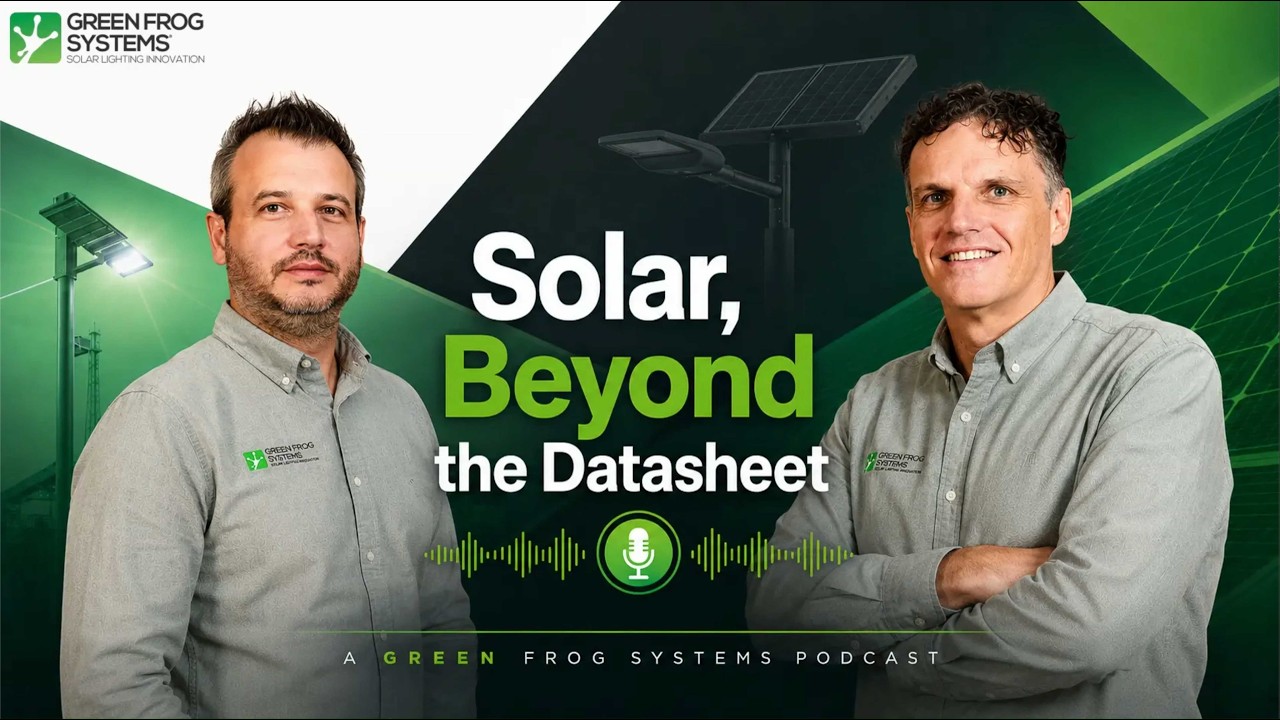
Solar panels are only one piece of the puzzle. Whether a solar lighting system performs for ten years or fails early comes down to the engineering decisions behind every component.
In Episode 3 of Solar, Beyond the Datasheet, CEO Douglas Bolzon and founder and CTO David Wilson take a deep dive into the technology: how it looked 15 years ago, what has changed, and where off-grid infrastructure is heading.
In this episode
Dave breaks a solar light down into its parts (panel, luminaire, controller, battery, pole and footing) and explains how each has evolved. Early controllers weren’t waterproof or rated for the 60–70°C heat inside a pole, and LED drivers were unreliable, so a lot of early engineering went into fixing other people’s components.
He also explains why Green Frog relies on long-term testing over datasheet ratings, including a two-year heat-chamber battery test and batteries pulled from real sites for analysis. The second half looks ahead: powering cameras, Wi-Fi and edge servers, the power pole as a future asset, embedded edge AI, and satellite-linked monitoring.
Key takeaways
- The controller is the brain. It regulates charging, protects the battery from heat, decides when it’s night and drives the light, all in a harsh environment for years.
- Datasheets aren’t field data. Components rated to 70–80°C can behave differently once combined inside a hot, humid pole.
- Testing at scale. Green Frog ran batteries at 65°C with rapid charge and discharge cycles non-stop for two years to model five-to-six-year performance.
- Proof from the field. Aspire batteries recovered from a hot inland site after more than five years kept well over 80% of their original capacity, according to Dave.
- Beyond lighting. Lower device power draw means solar systems now run cameras, long-range Wi-Fi and rugged edge servers that once needed huge systems.
- Edge AI and satellite. Next-generation controllers will learn from past weather and usage, process data locally and send small packets via satellite.
- Data helps partners grow. Dave says UK partner Acrospire used years of Green Frog field data to build the case for solar lighting in the UK.
Timestamps
- 00:00 Introduction
- 01:08 Breaking down a solar light, 15 years ago
- 03:14 Controllers and LED drivers: the early weak points
- 04:19 Early battery technology
- 05:22 Why grid-tied designs struggled off-grid
- 06:25 When datasheets meet harsh environments
- 08:32 What a solar controller actually does
- 09:32 Battery testing: two years in a heat chamber
- 12:41 Real-world field data from customer sites
- 14:42 How customer expectations have changed
- 16:49 From security lighting to mission-critical power
- 17:55 Predictive power and adaptive systems
- 18:59 Powering cameras, Wi-Fi and edge servers
- 21:06 The power pole as the asset of the future
- 24:13 Where battery technology is heading
- 26:22 Interconnectivity and edge AI
- 28:26 Satellite data and why reputation matters
- 31:33 Mining and other mission-critical applications
Related
- Battery technology explained
- Solar panels explained
- Myriota and Green Frog Systems: satellite remote monitoring
- Solar security and safety lighting
- Solar mining and industrial lighting
- Previous: EP002 – When a Founder Steps Aside · Next: EP004 – The Story Behind NOMAD
Listen on Spotify, YouTube, Deezer or Podchaser, or subscribe via RSS. See all episodes on the Solar, Beyond the Datasheet podcast page.



