


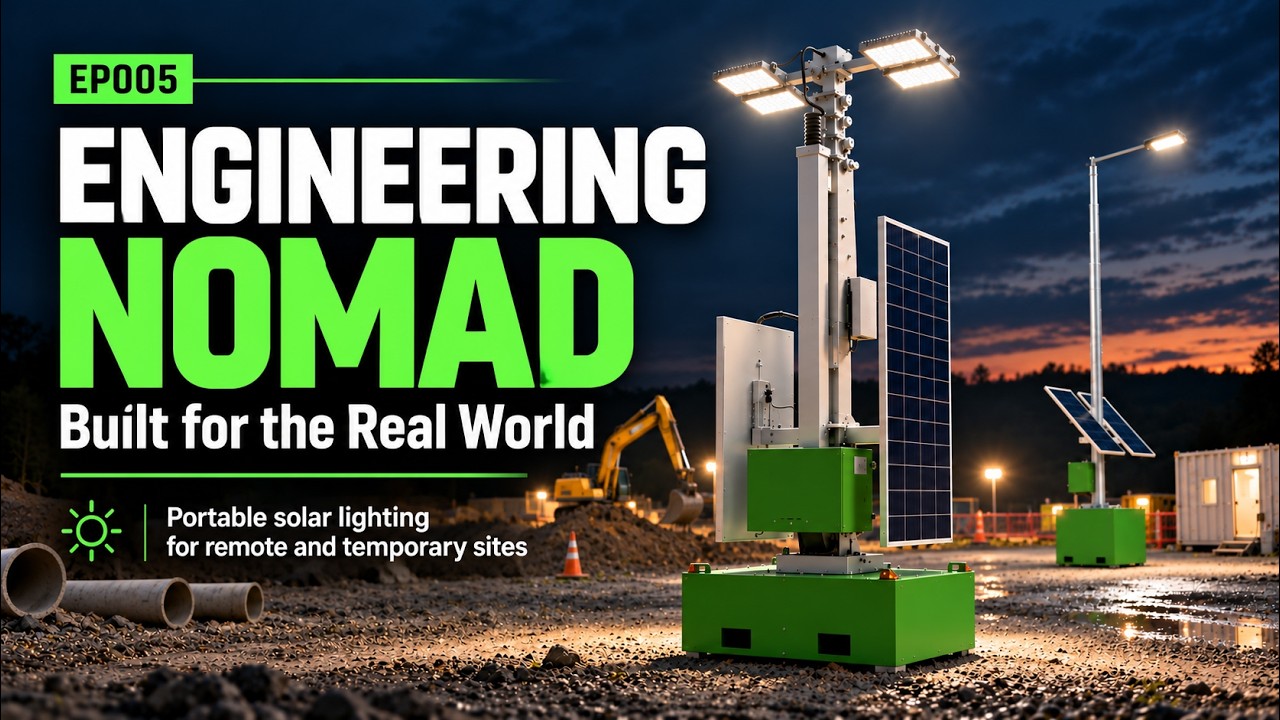
How do you build temporary solar lighting that fits a busy worksite, stands up to the wind and keeps working through the worst conditions?
In Episode 5 of Solar, Beyond the Datasheet, founder and CTO David Wilson joins CEO Douglas Bolzon for a closer look at the engineering behind the NOMAD range of solar lighting towers.
In this episode
Space is tight on most construction sites. Diesel towers need outriggers and bunting around them, so the first goal for NOMAD was the smallest footprint possible, with the pole, panels and luminaire kept up high and out of the way of plant and traffic. That creates its own challenge. A tall pole and large solar panels catch a lot of wind, so the ballast base has to hold everything down and still meet AS/NZS 1170.2, with independent certifying engineers signing off on the design.
Dave also explains why NOMAD’s solar panels rotate independently of the base. Crews can drop the unit where it’s needed, aim the light at the work area and turn the panels to face the sun, tilting them flatter in exposed locations to reduce wind load. From there the conversation moves to solar yield, battery capacity and autonomy, the job each NOMAD model is built for, and what buyers should check before trusting a datasheet.
Key takeaways
- Footprint matters on site. NOMAD sits hard up against barriers with no outriggers, keeping the technology high and clear of passing machinery.
- Panels turn, the base doesn’t. Rotating and tilting the panels independently makes orientation simple at intersections, and a lower tilt cuts wind load in high wind areas.
- Solar panel area does the heavy lifting. Generous panel area and battery capacity keep the lights on when dust, mud or days of winter fog cut generation, which matters most at haul roads and dangerous intersections.
- Three models, three jobs. NOMAD 1 for pathways, security and construction zones, NOMAD 2 for high output floodlighting that replaces a diesel tower, and NOMAD 4 for mine haul roads and remote intersections.
- Built to deploy fast. Units arrive complete, are filled with soil or sand on site and switched on. Dave notes up to 16 NOMAD 2 units fit in a single 40 ft high cube container, which suits large sites and disaster relief.
- Ask for the engineering. Look for verified wind data with the ballast in place, the maximum engineered wind speed, and the assumptions behind any autonomy claim.
Timestamps
- 00:00 Designing NOMAD for limited site space
- 02:23 Balancing footprint, wind loading and ballast
- 03:12 Making solar panel orientation simpler
- 05:31 Panel tilt, wind exposure and solar yield
- 06:34 Solar generation, battery capacity and autonomy
- 08:29 NOMAD 1: pathways, security and construction zones
- 08:57 NOMAD 2: high output floodlighting
- 09:43 NOMAD 4: mine haul roads and remote intersections
- 11:39 Customer feedback and deployment in practice
- 13:36 Transporting and deploying lighting at scale
- 14:47 Disaster relief and rapid response applications
- 15:14 What to look for beyond the datasheet
- 18:24 Designing for winter and maintaining light output
- 20:09 What’s next for NOMAD?
Related
- NOMAD solar lighting towers
- NOMAD 1 · NOMAD 2 · NOMAD 4
- Temporary solar lighting
- Solar mining and industrial lighting
- Previous: EP004 – The Story Behind NOMAD
Listen on Spotify, YouTube, Deezer or Podchaser, or subscribe via RSS. See all episodes on the Solar, Beyond the Datasheet podcast page.



