


What does temporary lighting really cost once you include freight, cranes, fuel and moving it to the next job?
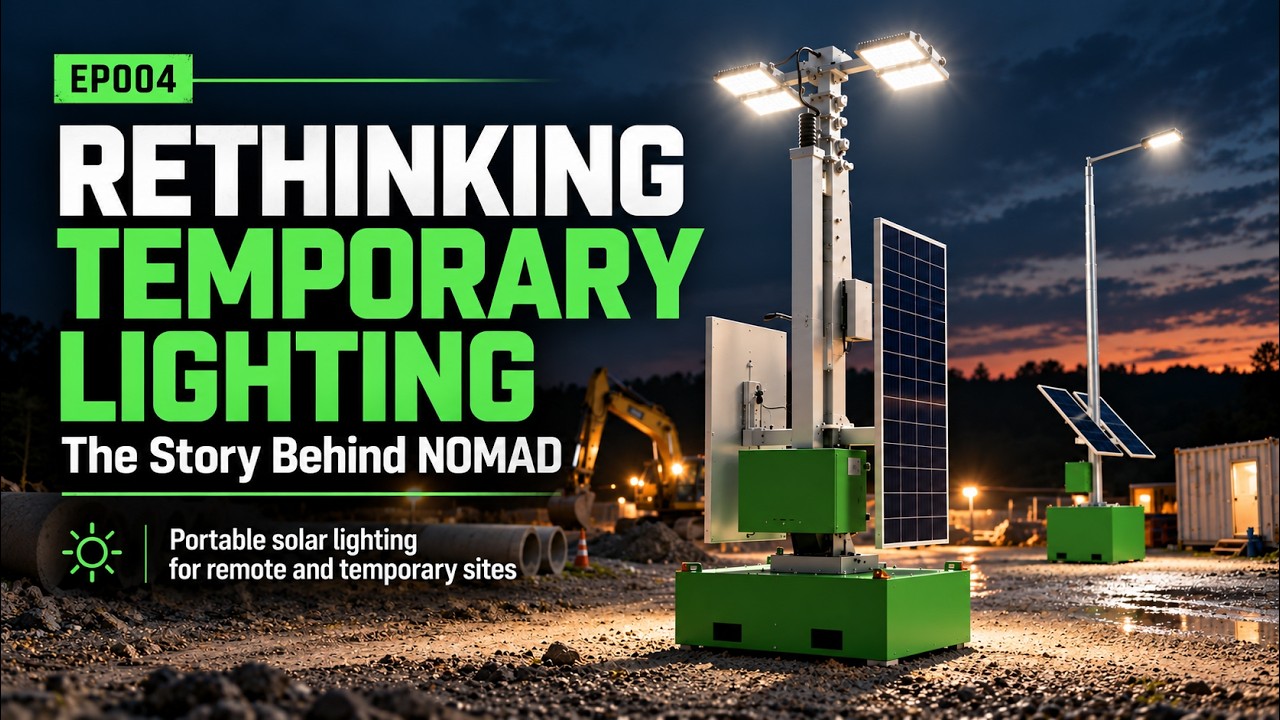
In Episode 4 of Solar, Beyond the Datasheet, founder and CTO David Wilson joins CEO Douglas Bolzon to explain the site challenges that inspired the NOMAD range of solar lighting towers.
In this episode
For years, temporary solar lighting meant bolting a light to a concrete block. That works for a small pathway light, but wind loading under AS/NZS 1170.2 can call for reinforced blocks of six or seven tonnes in high-wind regions. Every block then needs trucks, lifting equipment and a crane on site at the right time, and Dave recalls one quote of more than $25,000 to move blocks just 5 km.
At the same time, night works on major roads now need lighting that meets the same standard as the road before construction, and diesel lighting towers are built to light a work area rather than a stretch of road. Advances in LEDs, batteries and panel layout mean solar can now do that job. The answer was NOMAD: a steel base that ships light and is filled with sand or engineered aggregate on site.
Key takeaways
- Concrete costs more than concrete. Freight, cranes, double handling and emissions can make the real cost of a block-based light much higher than the block itself.
- Lighting expectations have risen. Road diversions and night works increasingly need compliant lighting, not just a diesel tower at each end.
- Diesel towers have running costs. Dave estimates even efficient towers burn 1–3 litres an hour, around $25 a day in fuel, and they suit spot lighting more than road lighting.
- Ship light, deploy heavy. NOMAD bases are transported empty, filled with local material on site, then emptied and moved to the next job, rented out, or recycled.
- Built with contractors. Construction companies chasing zero-emission sites asked Green Frog for an alternative, which drove 12–18 months of NOMAD development.
Timestamps
- 00:00 Introduction: temporary and remote solar lighting
- 00:53 From permanent installations to temporary solutions
- 03:06 The limitations of concrete bases
- 05:29 Freight, lifting and the real cost of deployment
- 08:03 Growing demands for construction site lighting
- 10:53 Diesel lighting towers versus solar
- 14:01 The challenges that inspired NOMAD
- 16:06 The ballast concept: ship light, deploy heavy
- 19:06 Developing the NOMAD range
Related
- NOMAD solar lighting towers
- NOMAD 1 · NOMAD 2 · NOMAD 4
- Temporary solar lighting
- Solar mining and industrial lighting
- Previous: EP003 – What Really Makes Solar Infrastructure Reliable?
Listen on Spotify, YouTube, Deezer or Podchaser, or subscribe via RSS. See all episodes on the Solar, Beyond the Datasheet podcast page.



